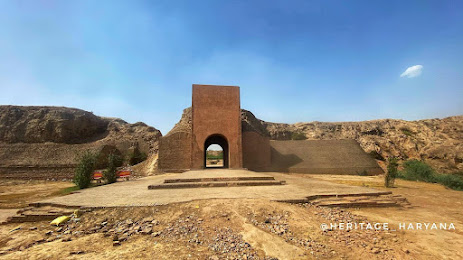
HISTORICAL WATER BODIES OF HARYANA Water is essential for life. Life is impossible without water. Therefore, water sources and structure related to them occupies great spaces in people’s lives. The water structures, about which we are talking, belong to the time gap of ancient time to colonial period. There are evidence of ancient water bodies which from Rakhigarhi, Banawli, and Kunal sites. Even during that time wells and ponds were used and after that kund and sarovar`s were made. Provision of drinking water was considered to be meritorious deed ‘punya karma’. Bawdi well, sekhawati well and talab were made in medieval period. Haryana has many water structures in different regions, many villages have sekhawati type stepwells built in 18 or 19 century which was used by local people. Later structures called johad were constructed as source of water . - Ancient Well in Banawli Most water structures are used for a variety of everyday and sacred activities, washin...
Popular posts from this blog
HAVELIS OF HARYANA
HAVELIS OF HARYANA -Haveli architecture is a unique vernacular architecture form that flourished in the 18th and 19th century in the pre-Partition western and North India, particularly in Rajasthan, Punjab Gujarat and Haryana influenced by cross-cultural currents from cental Asia, Islamic Persian and Rajput architecture, the haveli architecture was a direct response to the regional climate, while being a mirror of local art and landscape. Haveli means a mansion, and the word was derived from Arabic — probably taken from the Persian word hawli, meaning an enclosed place. Standing as a symbol of power and prestige, haveli householders were the noblemen, landowners or successful merchants. - Evidences of havelis in Haryana are found from the 16th century to the 21st century, first to see Hemu's (Hindu King Maharaja Vikramaditya )Haveli which is situated in Rewari, then after the 21st ce...
HANSI FORT
HANSI FORT Hansi is one of the ancient town and is identified with Asi or Asikare- ‘referred in Ashtadhyayi of Panini’. A Hansi stone inscription dated (Vikrama) Samvat 1224 and belonging to the Chauhan King Prithvi Raja II (now in the Royal Scottish museum at Edinburg also mentions the name of the town as Asika. The Tomars king was established a sword manufacturing factory in this fort, hence it is also called “Asigarh”. This site protected monument by ASI. Local traditions attribute the foundation of the town to Anangpal, the Tomar king of Delhi. Possibly, the town was destroyed earlier and re-founded by Anangpal. Arnoraja and following him, Vigraharaja completely subjugated the Tomars of Delhi and captured Hansi. The history of this fort has been from medieval India to modern India, whose history is related to Tomar king, Prithviraj Chauhan and George Thomas. George Thomas rebuilt the Hansi Fort and established a mint Hansi and released rupees of his ow...


👍👍👍
ReplyDelete